← Back to the anthology

Vertically oriented fiber arrays suppress splashing by restricting spreading of impacting drops

Three penetration regimes; vertical arrays suppress splash for all tested velocities, including beyond 5 m/s.

Gene Patrick S. Rible*, Syed Jaffar Raza, Joshua T. Watkins, Abbey Lin, Visalsaya Chakpuang, Andrew K. Dickerson
Department of Mechanical, Aerospace and Biomedical Engineering, University of Tennessee, Knoxville, Tennessee 37996, USA
*Contact researchers: grible@vols.utk.edu

Physics of Fluids 37, 092106 (2025)

Abstract

This experimental work builds on our previous studies on the post-impact characteristics of drops striking three-dimensional-printed fiber arrays by investigating the highly transient characteristics of impact. We measure temporal changes in drop penetration depth, lateral spreading, and drop dome height along the fiber array at the drop impacts. Liquid penetration of vertical fibers can be divided into three sequential periods with linearly approximated rates of penetration: (i) an inertial regime, where penetration dynamics are governed by inertia; (ii) a transitional regime exhibiting inertial and capillary action; and (iii) a capillary regime characterized purely by downward wicking. Horizontal fibers exhibit only the inertial and transitional stages, with wicking only observed horizontally along the direction of fibers. In horizontal hydrodynamic fiber arrays, the time duration to reach the maximum lateral deformation of the depth is proportional to We¹ᐟ⁴, as observed in drops impacting solid surfaces. There exists a critical Weber number below which the drop shows no radial deformation, and the critical value increases with decreasing fiber density. At large Weber numbers, drops splash. In contrast, vertical fibers restrict the lateral spreading of the drop, thereby suppressing a splash for all tested drop velocities, even those exceeding 5 m/s.

Firsts in this work

New experimental tools and observations from this paper.

How it works and what we found

Three sequential penetration regimes on vertical fibers

Movie 2: Temporal events in drop spread and penetration

Movie 3: Three penetration regimes, inertial / inertial-capillary / capillary
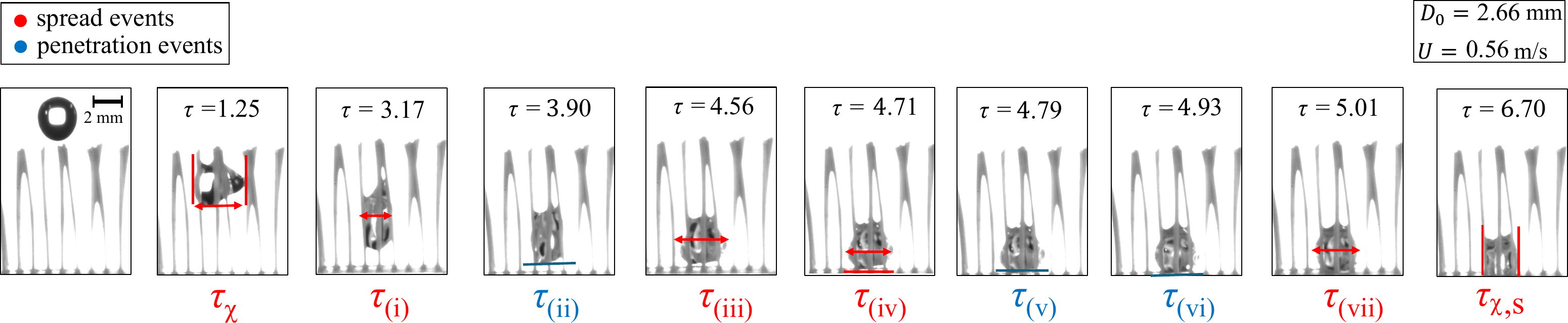
Figure 4 from the paper: image sequence showing the characteristic temporal events in the spreading and penetration of liquid within the array for a single trial.
Figure 6 from the paper: three regimes characterizing the penetration behavior of a drop impacting a vertical fiber array: inertial, inertial-capillary, and capillary.

Time-resolved imaging reveals three linearly-approximated penetration rates: an inertial period, a transitional period (inertia plus capillarity), and a final capillary period of pure downward wicking.

Lateral deformation: We¹ᐟ⁴ scaling

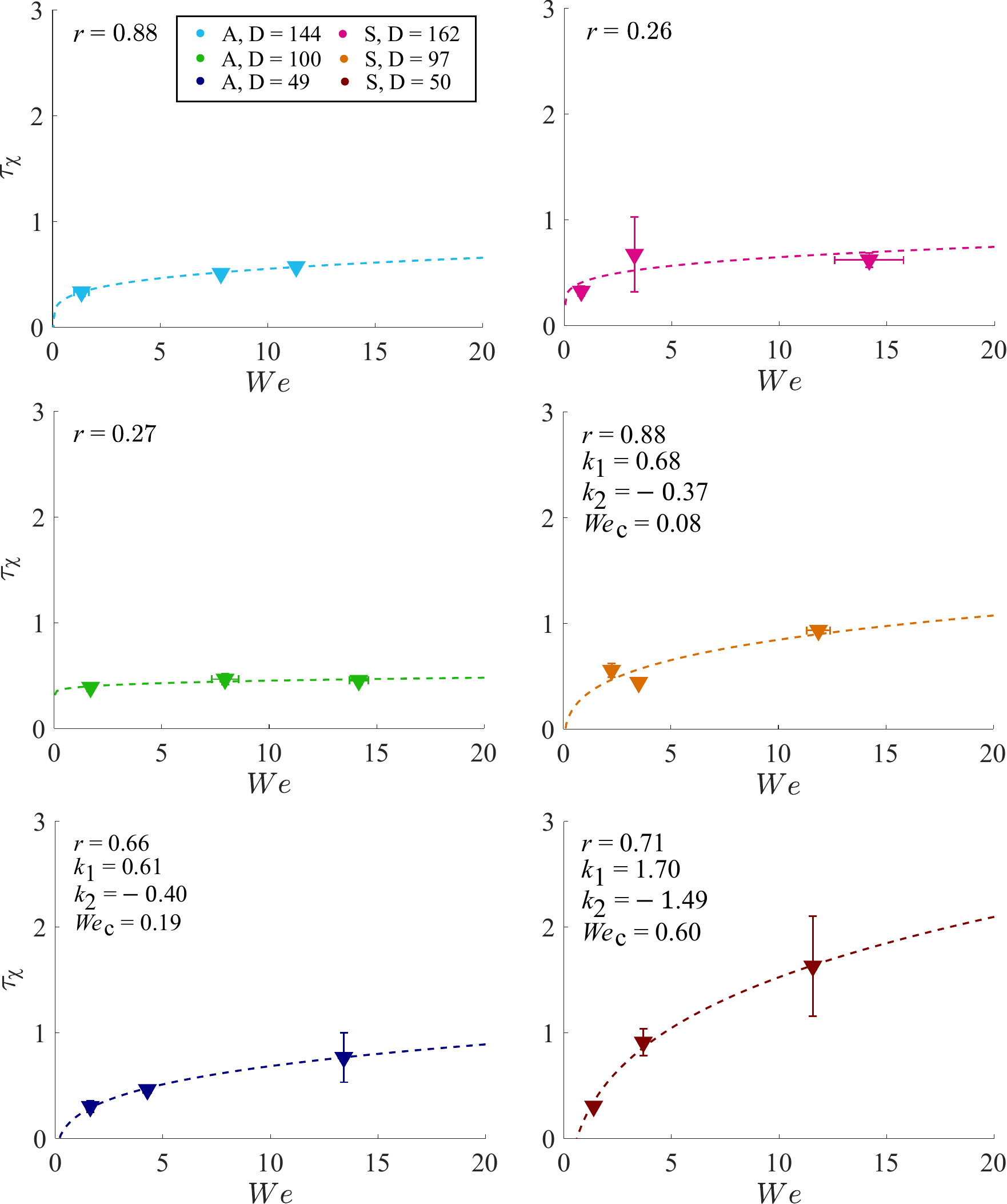
Figure 10 from the paper: first instance of local maximum spread vs Weber number for hydrophilic horizontal fibers, with linear scaling fits across multiple densities.

On horizontal arrays, the time to reach maximum lateral deformation scales with We¹ᐟ⁴, mirroring drops on solid surfaces.

A critical Weber number for radial deformation

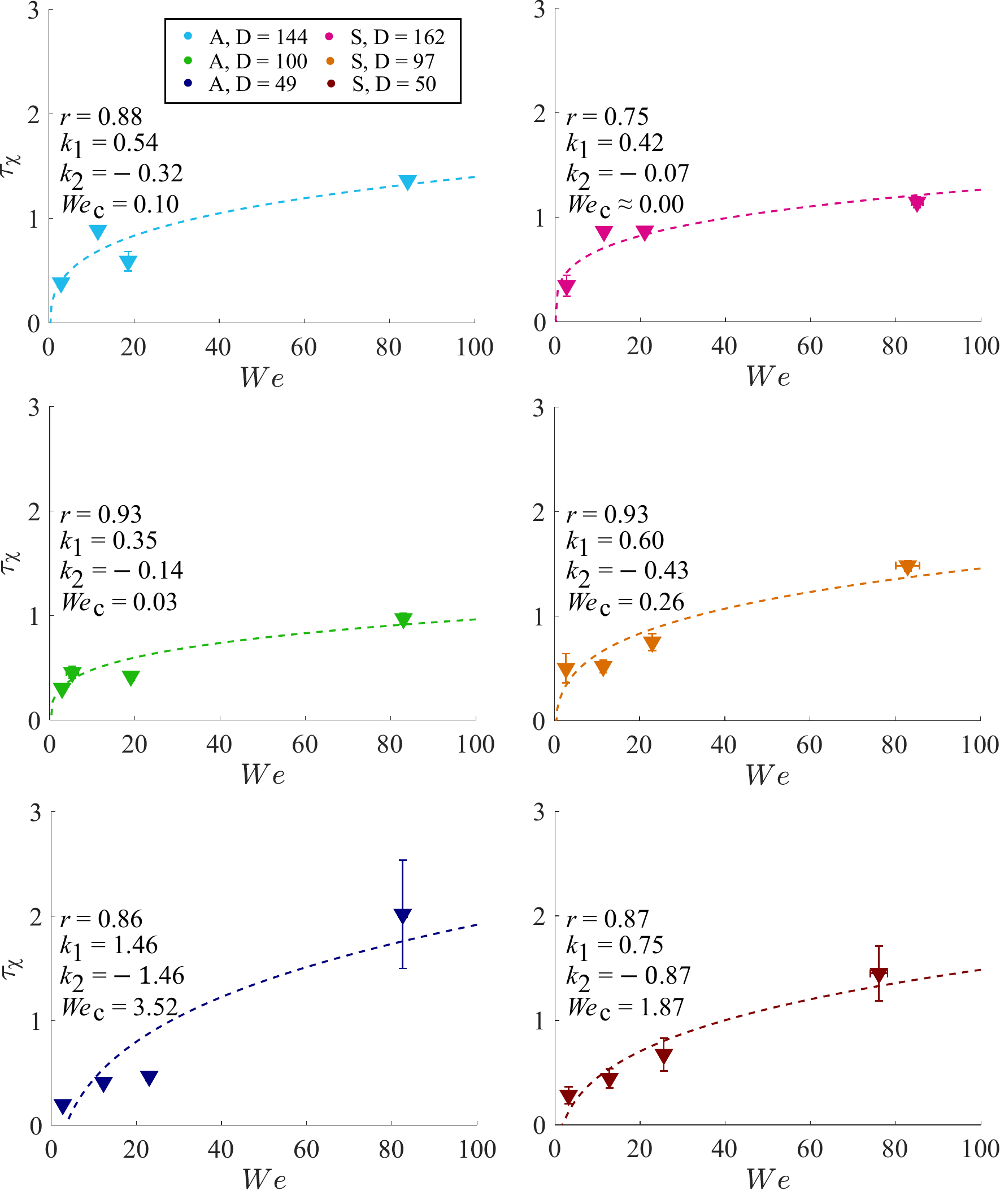
Figure 12 from the paper: first instance of local maximum spread vs Weber number for hydrophilic vertical fibers, with the critical Weber number printed on each panel.

Below this critical value the drop barely spreads; the threshold rises as fiber density drops.

Vertical arrays suppress splash

Movie 1: Drop on solid, horizontal, and vertical arrays at raindrop speed

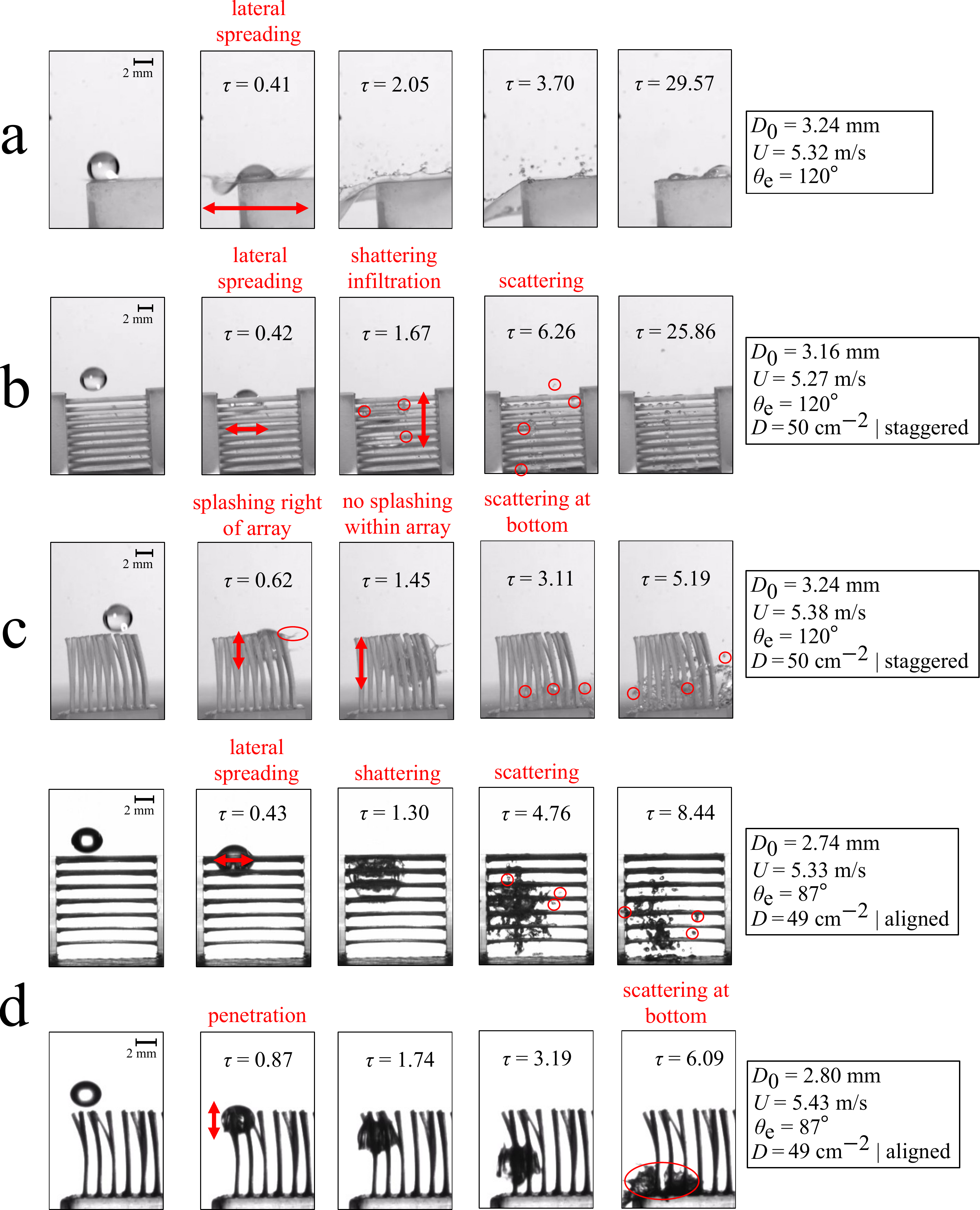
Figure 3 from the paper: image sequence of a 3 mm drop impacting at raindrop speed on a solid surface, a horizontal fiber array, a vertical fiber array, and a side-by-side comparison. Shows splash on solid and horizontal, suppression on vertical.

Because vertical fibers restrict lateral motion of the impacting liquid, splash is suppressed for all drop velocities we test, including impacts faster than 5 m/s.

Supplementary videos

Watch all of them as a playlist on YouTube →

Movie 1: Drop on solid, horizontal, and vertical arrays at raindrop speed

A 3 mm drop impacting at raindrop speed (≈5.3 m/s) on a solid surface, a horizontal fiber array, and a vertical fiber array. The drop splashes on the solid and horizontal cases but the vertical array suppresses the splash. Pairs with Fig. 3.

Movie 2: Temporal events in drop spread and penetration

Image sequence showing the characteristic temporal events in the spreading and penetration of liquid within a vertical fiber array: maximal spread, rebound, secondary spread, and the approach to steady state. Pairs with Fig. 4.

Movie 3: Three penetration regimes, inertial / inertial-capillary / capillary
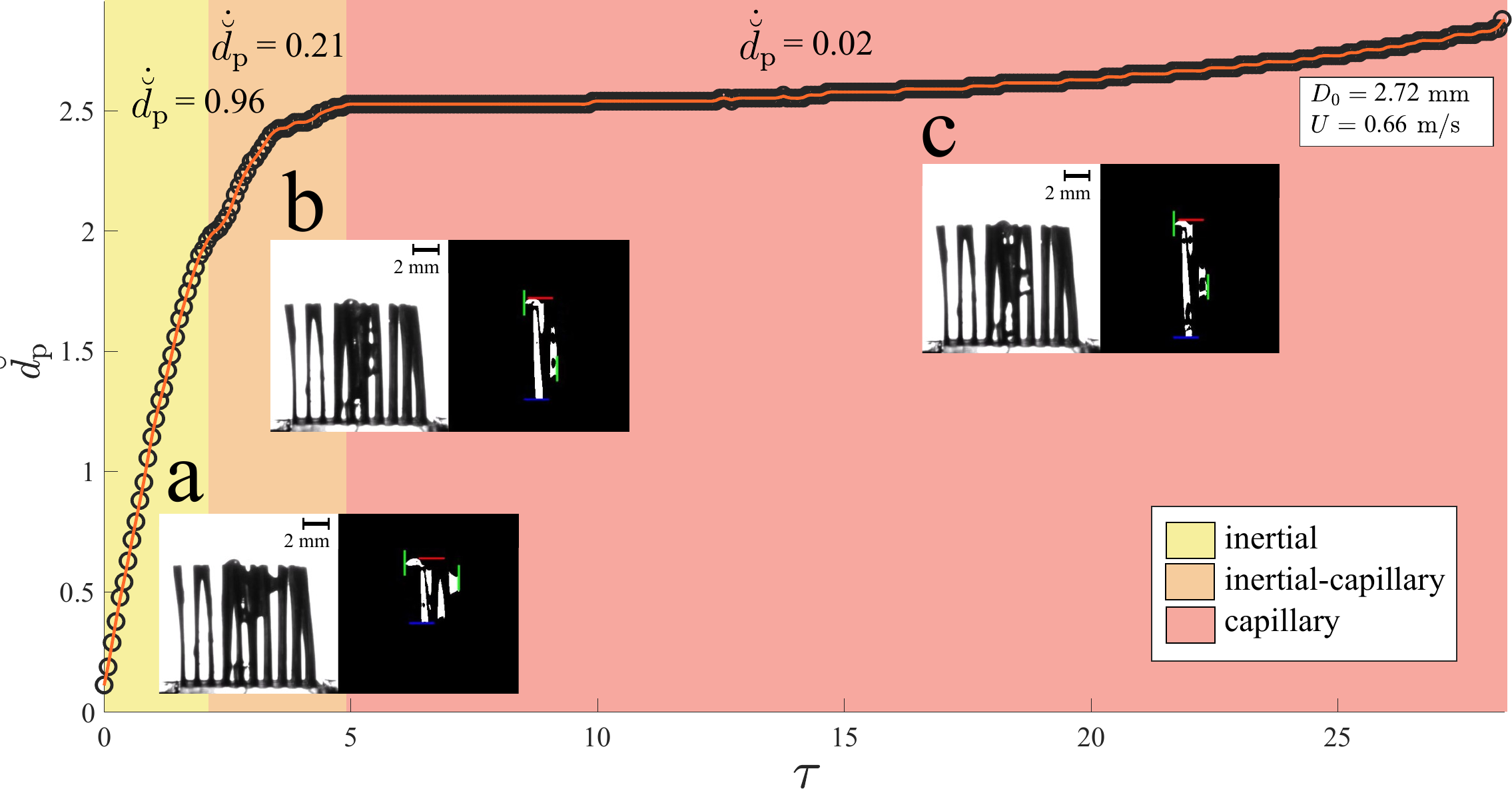
The three regimes characterizing penetration of a drop into a vertical fiber array: an inertial regime, a transitional inertial-capillary regime, and a final capillary regime of pure downward wicking. Pairs with Fig. 6.

Citation

@article{rible2025splash,
  author  = {Rible, Gene Patrick S. and Raza, Syed Jaffar and Watkins, Joshua T. and Lin, Abbey and Chakpuang, Visalsaya and Dickerson, Andrew K.},
  title   = {Vertically oriented fiber arrays suppress splashing by restricting spreading of impacting drops},
  journal = {Physics of Fluids},
  volume  = {37},
  number  = {9},
  pages   = {092106},
  year    = {2025},
  doi     = {10.1063/5.0286271}
}

Acknowledgments

This research was partially funded by the National Science Foundation (CMMI 1825801 and CBET 2205558). We thank undergraduate research assistants at the Fluids and Structures Laboratory, Hadi Bhidya for bespoke code and video analysis contributions, and Aaron Matheny for performing drop impact experiments at raindrop velocities.

Discussion

Questions, comments, and follow-up work. Sign in with GitHub to post.