← Back to the anthology

Sequential drop impacts onto horizontal fiber arrays

Two drops in a row: fragmentation of the first limits the lateral and depth growth of the second.

Gene Patrick S. Rible*, Agustin Soto, Regina C. Shome, Andrew K. Dickerson
1Department of Mechanical, Aerospace and Biomedical Engineering, University of Tennessee, Knoxville, Tennessee 37996, USA
2College of Computing, Georgia Institute of Technology, Atlanta, Georgia 30332, USA
*Contact researchers: grible@vols.utk.edu

Physics of Fluids 37, 072128 (2025)

Abstract

We experimentally investigate liquid infiltration into horizontally oriented fiber arrays imposed by sequential drop impacts. Our experimental system is inspired by mammalian fur coats, and our results provide insight into how we expect natural fibers to respond to falling drops and the structure nature gives to this hierarchic covering. Two successive drop impacts are filtered through three-dimensional printed fiber arrays with varying densities, surface wettability, and fixed fiber diameter. The penetration depth and the lateral width of drop spreading within fiber layers are functions of drop displacement relative to the liquid already within the array as well as the drop Weber number. Hydrophobic fibers more effectively prevent an increase in penetration depth by the second impacting drop at low impact Weber numbers, whereas hydrophilic fibers ensure lower liquid penetration depth into the array as the Weber number increases. Impact outcomes, such as penetration depth and lateral spreading, are insensitive to impact eccentricity between the first and second drop at high experimental Weber numbers. As expected, denser, staggered fibers reduce infiltration, preventing the entire drop mass from entering the array. Fragmentation of the first drop, which is promoted by hydrophobicity, larger inter-fiber spacing, and higher drop impact velocity, limits increases in lateral spreading and penetration depth of the liquid mass from a subsequent drop.

Firsts in this work

New experimental tools and observations from this paper.

How it works and what we found

Two-drop experiments on hydrophilic and hydrophobic arrays

Movie 3: Rebound classifications, Jet-Bulb / Jet / Little / None
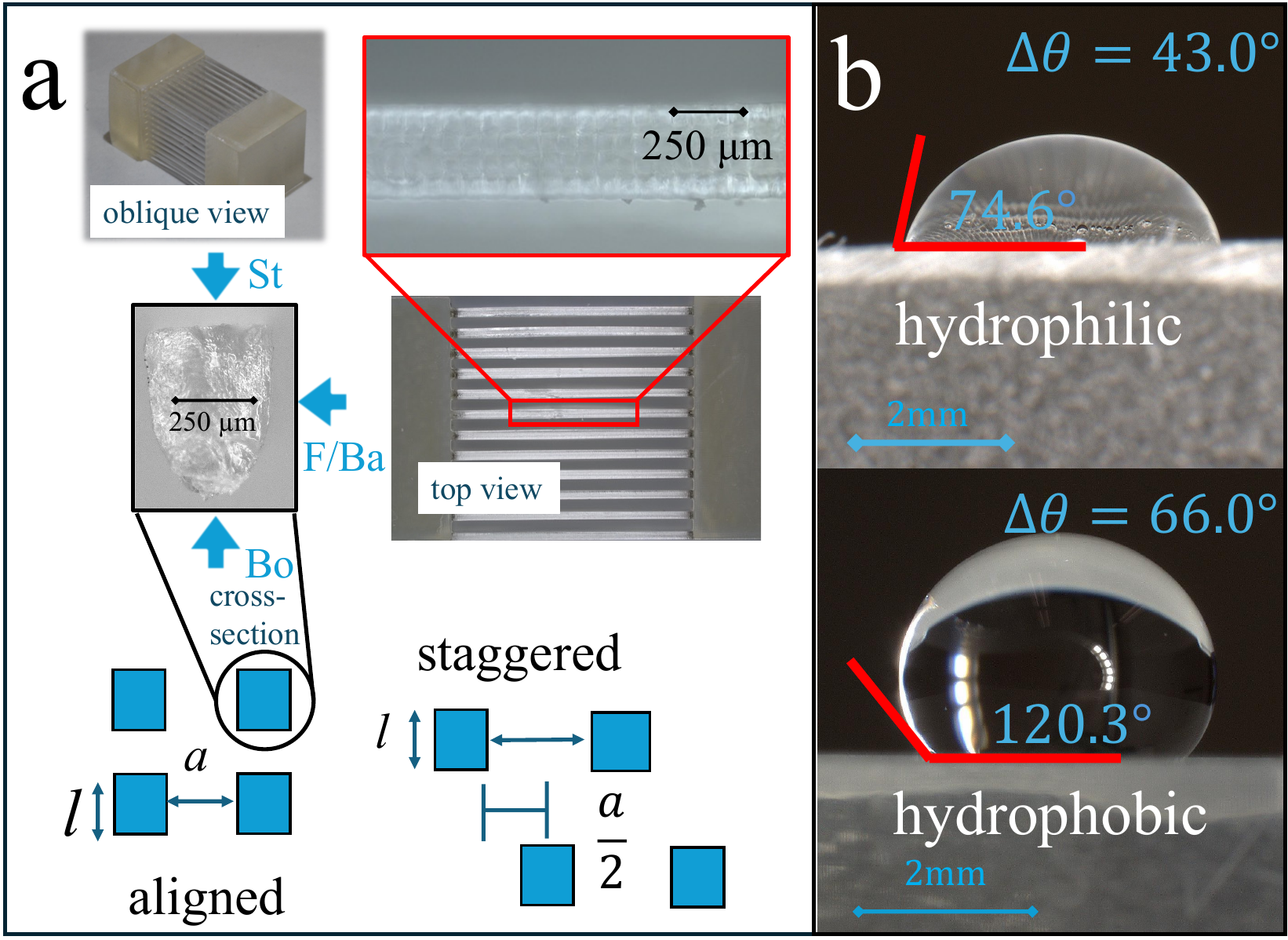
Figure 1 from the paper: 3D-printed fiber arrays in staggered and aligned configurations across standard, front-and-back, and bottom orientations, plus contact-angle photos of hydrophilic and hydrophobic samples.
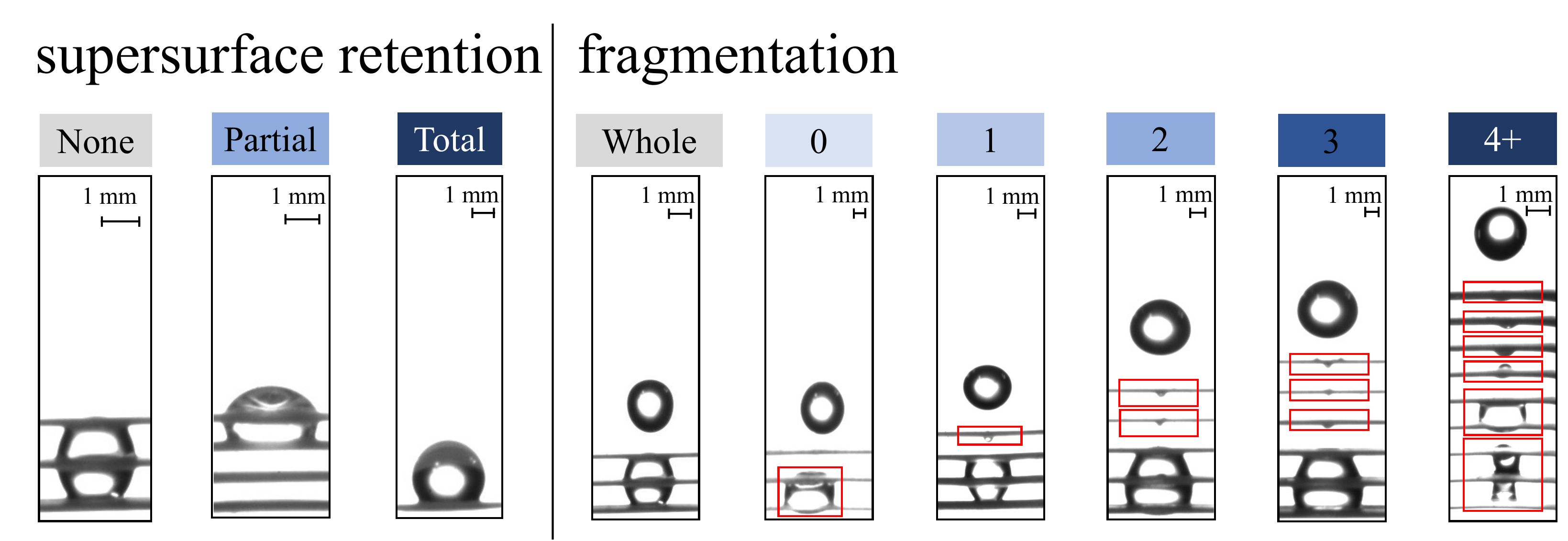
Figure 4 from the paper: classifications of supersurface retention (None / Partial / Total) and fragmentation (Whole / 0 / 1 / 2 / 3 / 4+) of liquid within the array.

We deliver two drops in quick succession onto 3D-printed horizontal fiber arrays with varying density and wettability, tracking how the second impact alters the wetted depth and width established by the first.

Impact eccentricity loses its grip at high Weber number

Movie 1: Drop displacement vs Weber number, image sequences

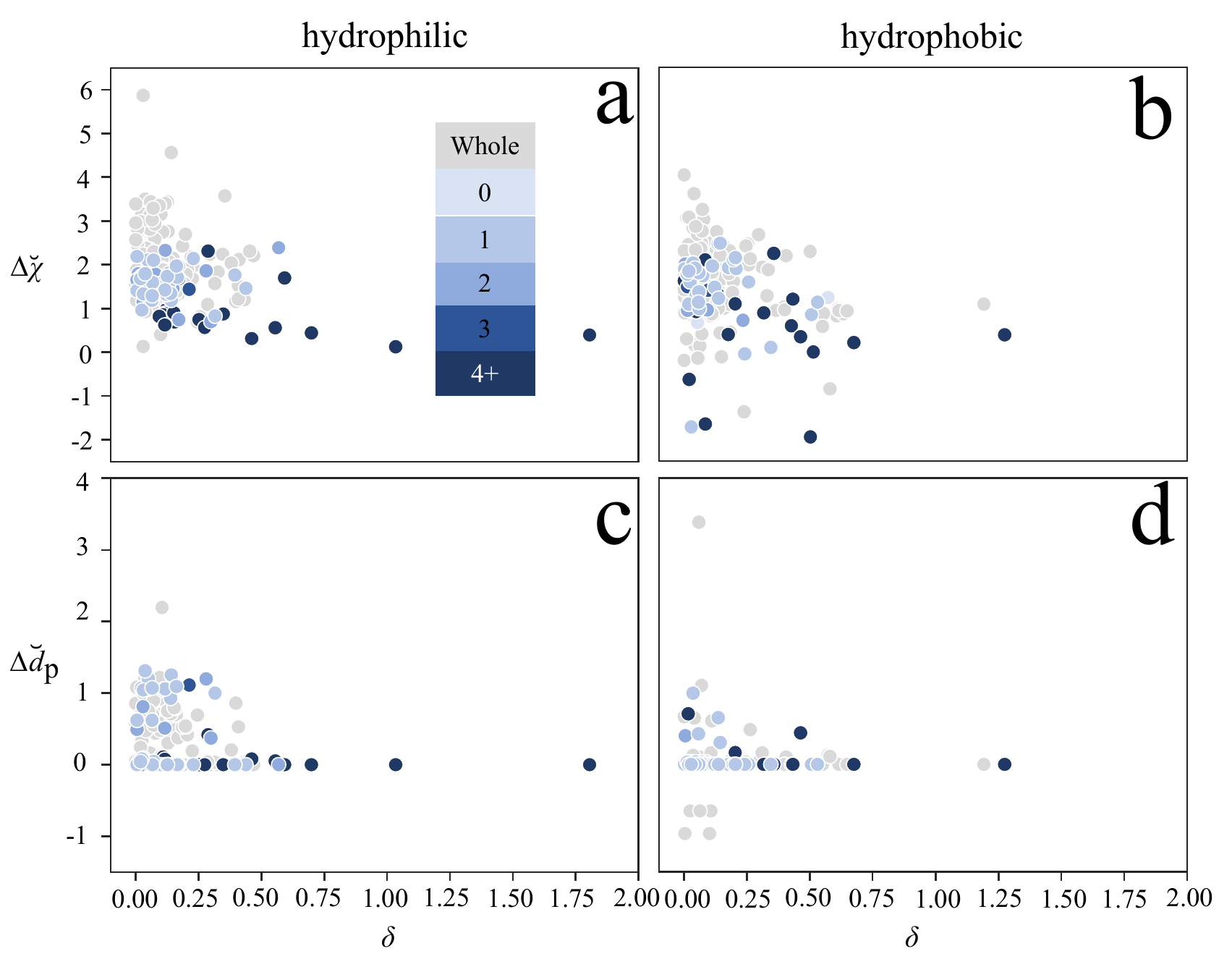
Figure 10 from the paper: change in penetration depth within the aligned array imposed by the second drop. Top row: depth change versus the dimensionless horizontal displacement between drops. Bottom row: depth change versus impact Weber number. Colors indicate the degree of fragmentation.

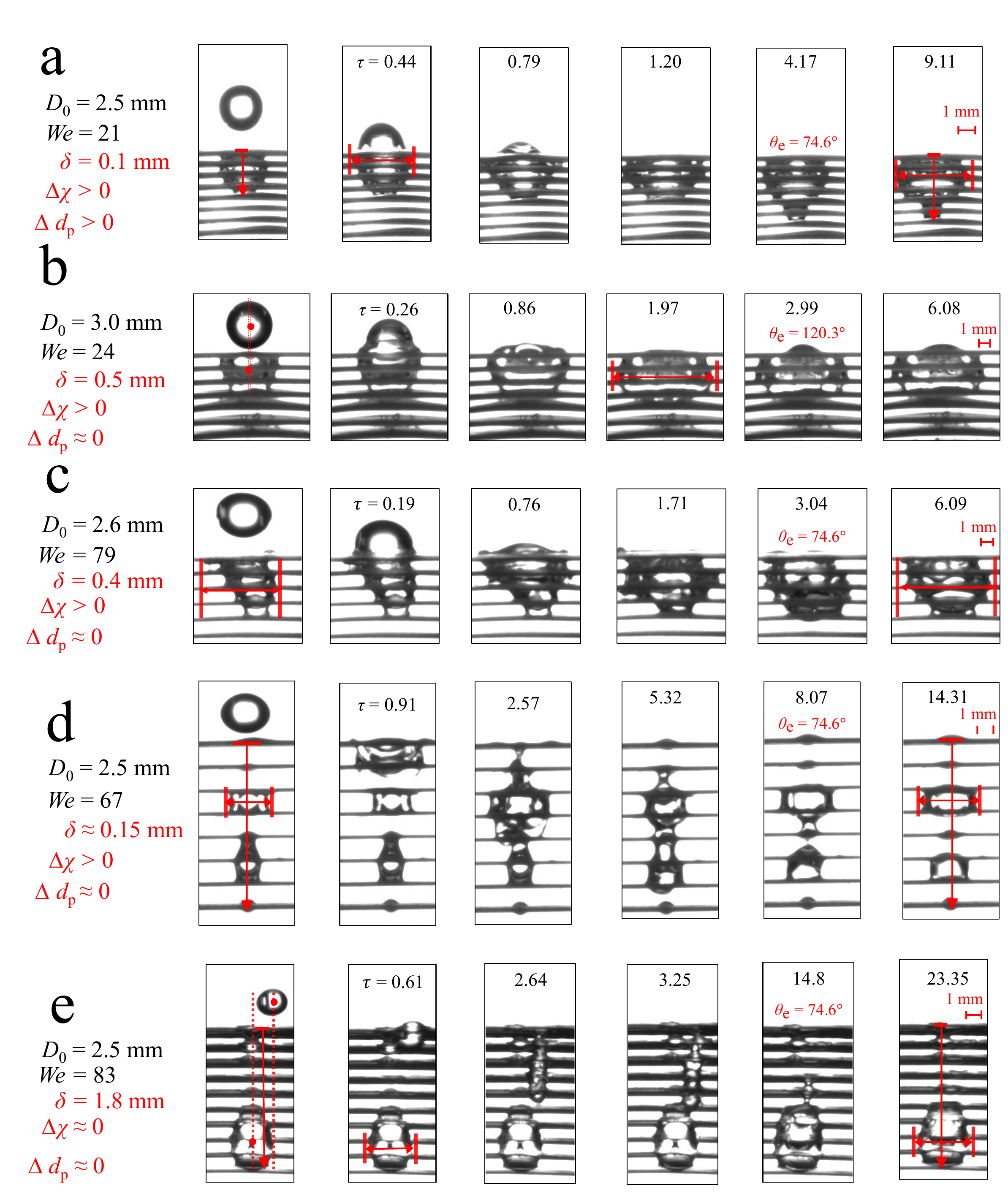
At low We, offset between drops changes the outcome; at high We, the impact dynamics swamp the local detail of where the second drop lands.

Fragmentation of the first drop protects against the second

Figure 7 from the paper: five-row image sequences showing how the second drop's displacement and the impact Weber number control liquid spread and penetration-depth change, including delta about 0 vs delta greater than 0 contrasts at low and high Weber numbers, plus a fragmentation case and a high-eccentricity case.

Hydrophobicity, large inter-fiber spacing, and high impact velocity all promote fragmentation of the first drop, which redirects mass away from the array and limits the second drop's contribution to penetration.

Hydrophobic helps at low We; hydrophilic at high We

Movie 2: Wettability crossover at low and high Weber number

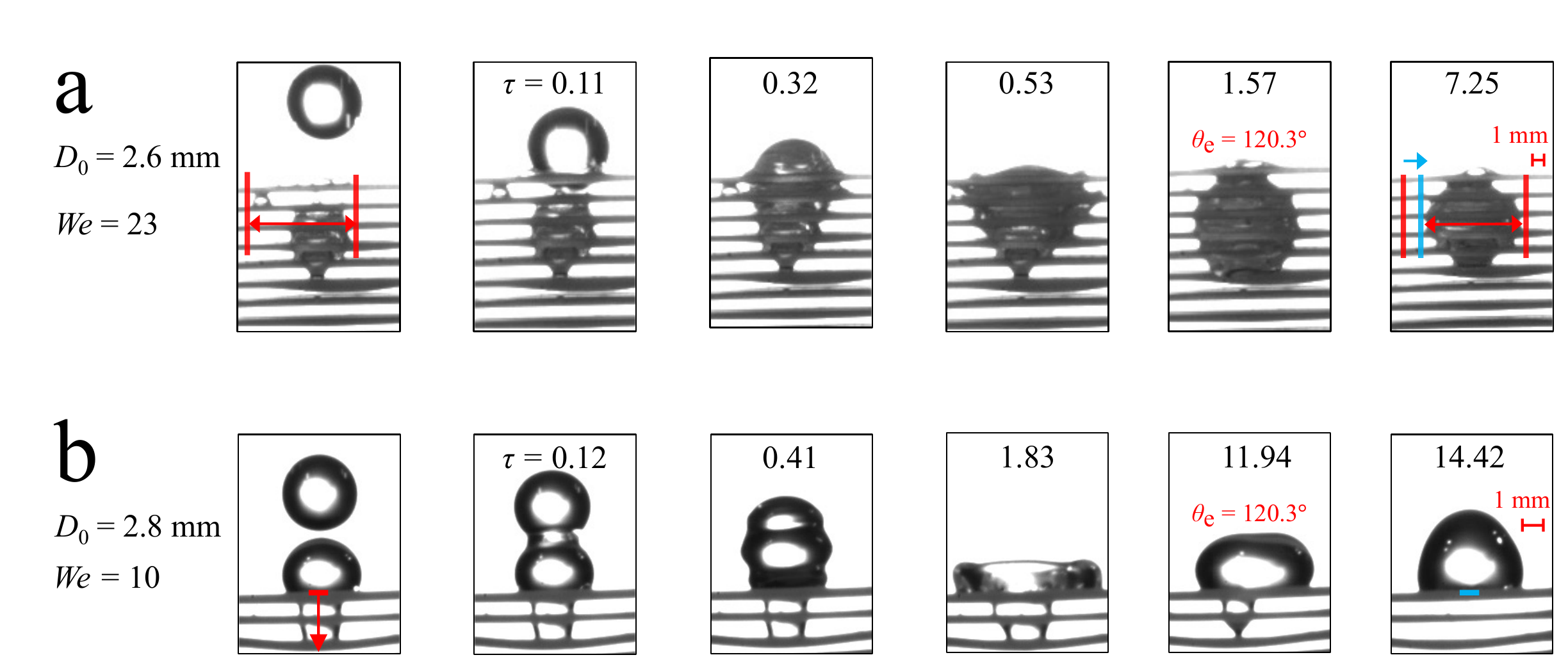
Figure 8 from the paper: (a) hydrophilic fibers allow a reduction in spread at high Weber number. (b) Hydrophobic fibers allow a reduction in penetration depth at low Weber number. The two-panel wettability crossover for sequential impacts.

Below a Weber-number threshold, hydrophobic fibers minimize the second drop's depth increase. Above it, hydrophilic fibers do so via lateral spreading.

Supplementary videos

Watch all of them as a playlist on YouTube →

Movie 1: Drop displacement vs Weber number, image sequences

Image sequences showing how the displacement of the second drop relative to the first (δ) and the impact Weber number control the change in liquid spread and penetration depth. Pairs with Fig. 7.

Movie 2: Wettability crossover at low and high Weber number

Two cases that flip with We: (a) hydrophilic fibers allow a reduction in spread of the second drop at high We; (b) hydrophobic fibers allow a reduction in penetration depth at low We. Pairs with Fig. 8.

Movie 3: Rebound classifications, Jet-Bulb / Jet / Little / None
Classifications of the rebound shape after sequential drop impacts on horizontal fiber arrays: Jet-Bulb, Jet, Little, and None. Each frame is timestamped by dimensionless time. Pairs with Fig. 11.

Citation

@article{rible2025sequential,
  author  = {Rible, Gene Patrick S. and Soto, Agustin and Shome, Regina C. and Dickerson, Andrew K.},
  title   = {Sequential drop impacts onto horizontal fiber arrays},
  journal = {Physics of Fluids},
  volume  = {37},
  number  = {7},
  pages   = {072128},
  year    = {2025},
  doi     = {10.1063/5.0281512}
}

Acknowledgments

This research was partially funded by the National Science Foundation (CMMI 1825801 and CBET 2205558). We thank Isabelle Garrett, an undergraduate research assistant at the Fluids and Structures Laboratory, for editing the image sequences and supplemental videos.

Discussion

Questions, comments, and follow-up work. Sign in with GitHub to post.