In this experimental study, we combine drop impact into porous media and onto a single fiber to study drop impact into fiber arrays inspired by mammalian fur coats. In our 3D-printed arrays, we vary the packing density, fiber alignment, strand cross-section, and wettability. Drops impact fibers fixed at both ends, penetrating over short times by momentum and laterally spreading throughout the array. Using image analysis, we measure penetration depth, and wetted width into the array. Impact Weber number and intrinsic porosity define penetration, retraction, and rebound regimes. On average, at an impact Weber number of ≈80, staggered fibers reduce penetration by 24% in hydrophilic fibers and 34% in hydrophobic fibers, and the penetration reduction percentage is expected to increase with increasing Weber number. Our results indicate that as density grows toward the density of mammalian pelts, penetration will reach a maximum value independent of drop impact velocity, thereby providing an effective rain barrier. Hydrophilicity at the densities we test, 50-150 strands/cm², aids fiber array resistance of dynamic penetration by impacting drops through the promotion of lateral drop spreading and inhibition of drop fragmentation. Conversely, hydrophobic fibers best resist low-speed wicking. The fraction of a drop that infiltrates hydrophilic and hydrophobic fibers is nearly identical for a fixed Weber number because lateral spreading restricts the penetration depth into hydrophilic fibers but does not restrict mass infiltration. Above a critical Weber number, the entire drop mass percolates fiber arrays regardless of strand wettability.
How it works and what we found
Hydrophilic fibers resist dynamic penetration better than hydrophobic
Movie S5: ≈5 m/s impacts, hydrophilic vs hydrophobic
Movie S1: Impact classifications
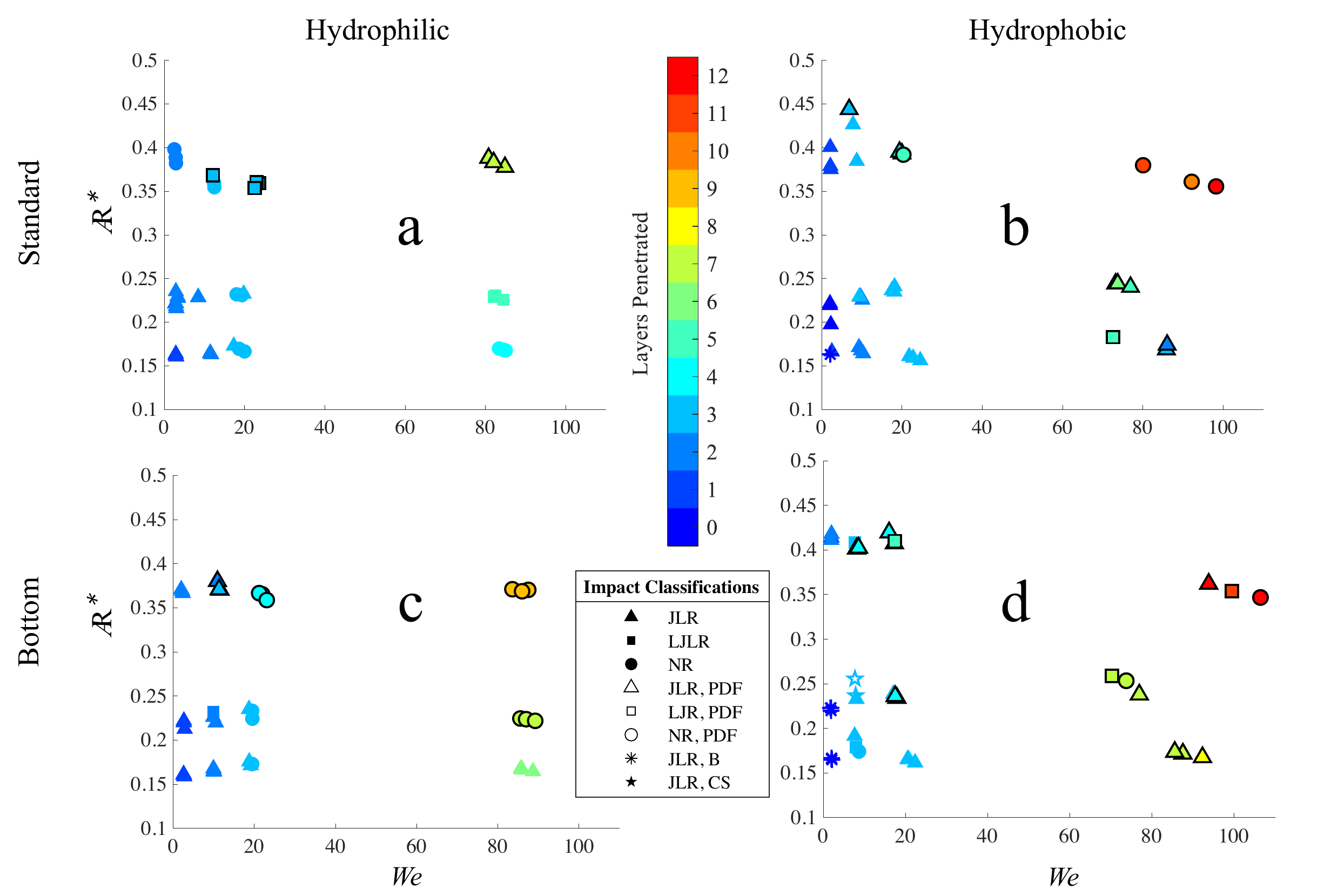
Modified fiber aspect ratio (AR*) versus Weber number for hydrophilic (left) and hydrophobic (right) arrays in standard (top) and bottom (bottom) orientations, colored by the number of penetrated layers. AR* is the inter-fiber spacing normalized by the drop diameter; a lower AR* means the impacting drop sees a denser array. The counter-intuitive main finding of the paper: at the tested densities (50-150 strands/cm²), hydrophilic horizontal arrays best resist raindrop impact. They do it by promoting lateral spreading (which redirects kinetic energy out across the array surface) and inhibiting drop fragmentation (which would otherwise let small daughter droplets dive deeply between strands). Hydrophobic fibers do neither; they let the drop fragment and penetrate further at dynamic velocities. In the legend, PDF stands for “penetrated drop fragmentation”: points drawn with a black outline (□) represent drops that fragmented during impact; solid markers (■) are non-fragmenting drops.
A critical Weber number marks the wettability crossover
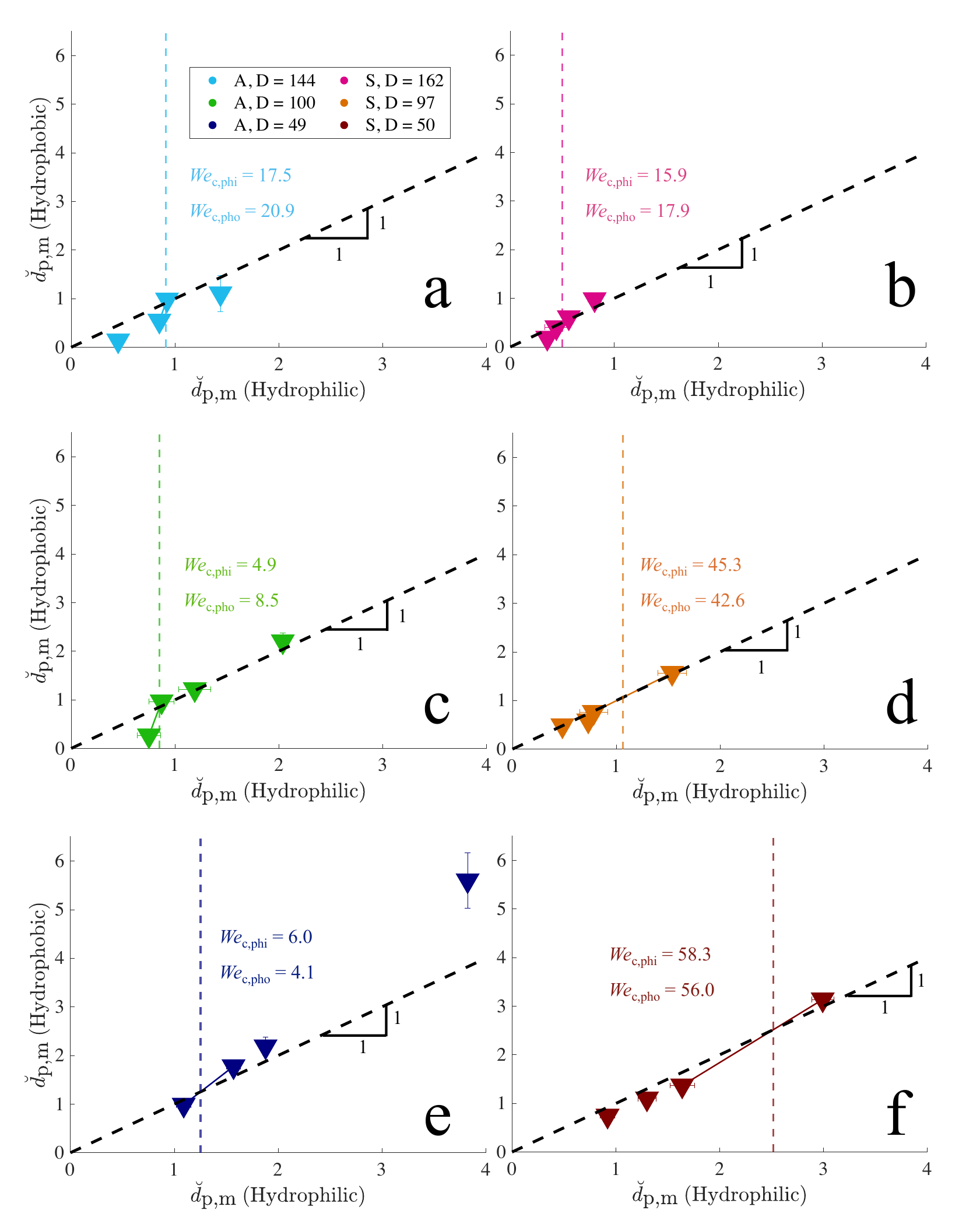
Normalized maximum penetration depth in hydrophobic fibers versus the same quantity in hydrophilic fibers, panel by panel for each density. Vertical lines mark the critical Weber number (Wec) at which hydrophobic penetration starts exceeding hydrophilic. Below Wec the hydrophobic case penetrates less (the static / low-speed wicking regime where hydrophobicity helps). Above Wec the hydrophilic case takes over and resists better (the dynamic / raindrop regime). The per-density Wec values are printed on each panel. At raindrop velocities (≈5 m/s, see Movie S5 below), hydrophobic arrays shatter the drop and let it fully percolate the array; hydrophilic arrays still stop it at a finite depth.
3D-printing fur-inspired fiber arrays
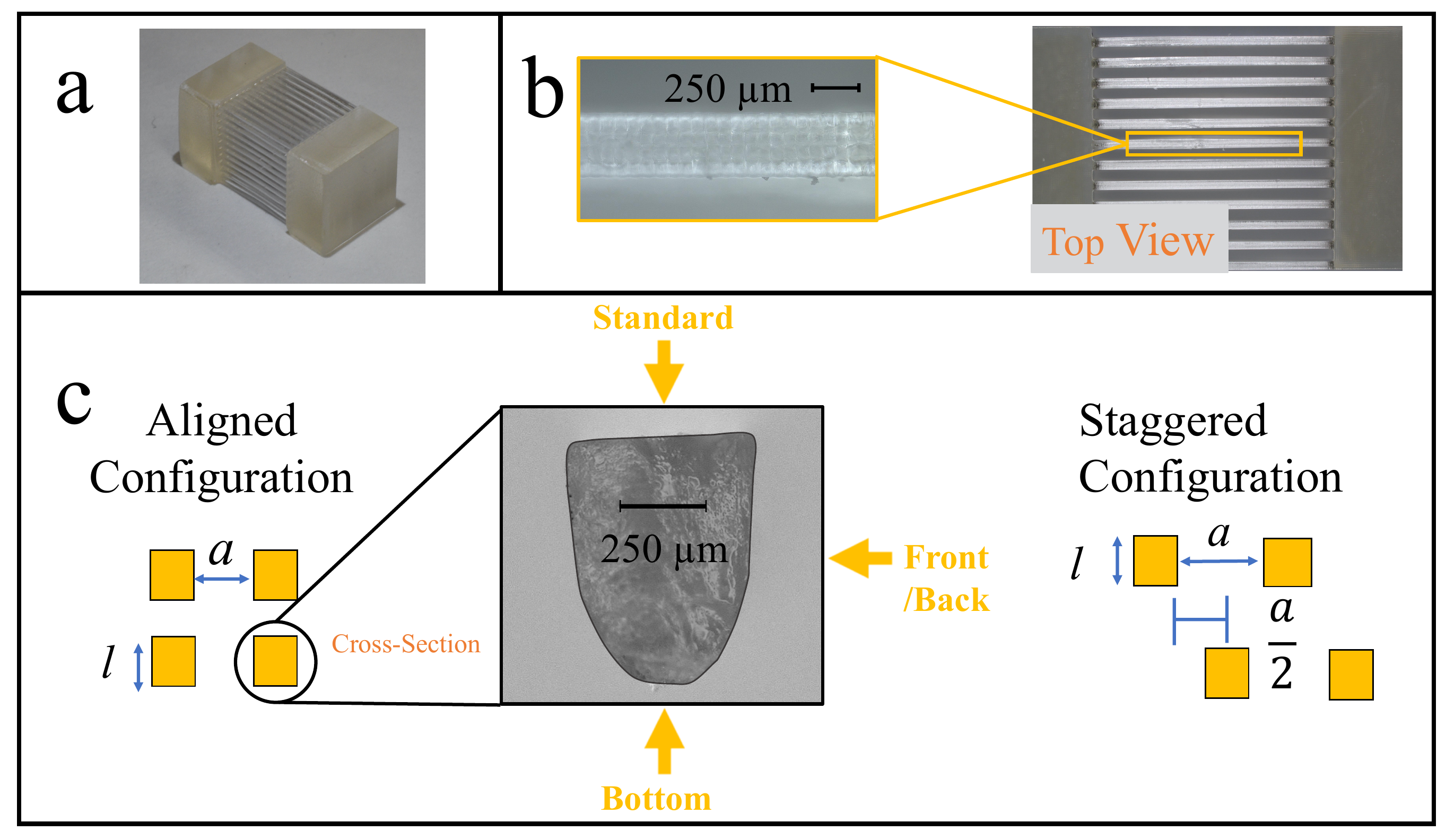
Drop-impact literature has historically split into three camps: solid surfaces, porous media, and single fibers. This work bridges the porous-media and single-fiber camps by producing resin-3D-printed fiber arrays sized and packed like mammalian fur (50-150 strands/cm²) and then dropping water on the whole array rather than on a single strand. Fixing each fiber at both ends eliminates cantilever beam dynamics, isolating the wetting physics. Density, alignment, strand cross-section, and wettability are all independently controlled. Two configurations are tested: aligned (square grid) and staggered (every other row shifted by half a cell). Staggered arrangements consistently reduce penetration relative to aligned arrays of identical density, by up to 34% at We ≈ 80.
Penetration saturates with density
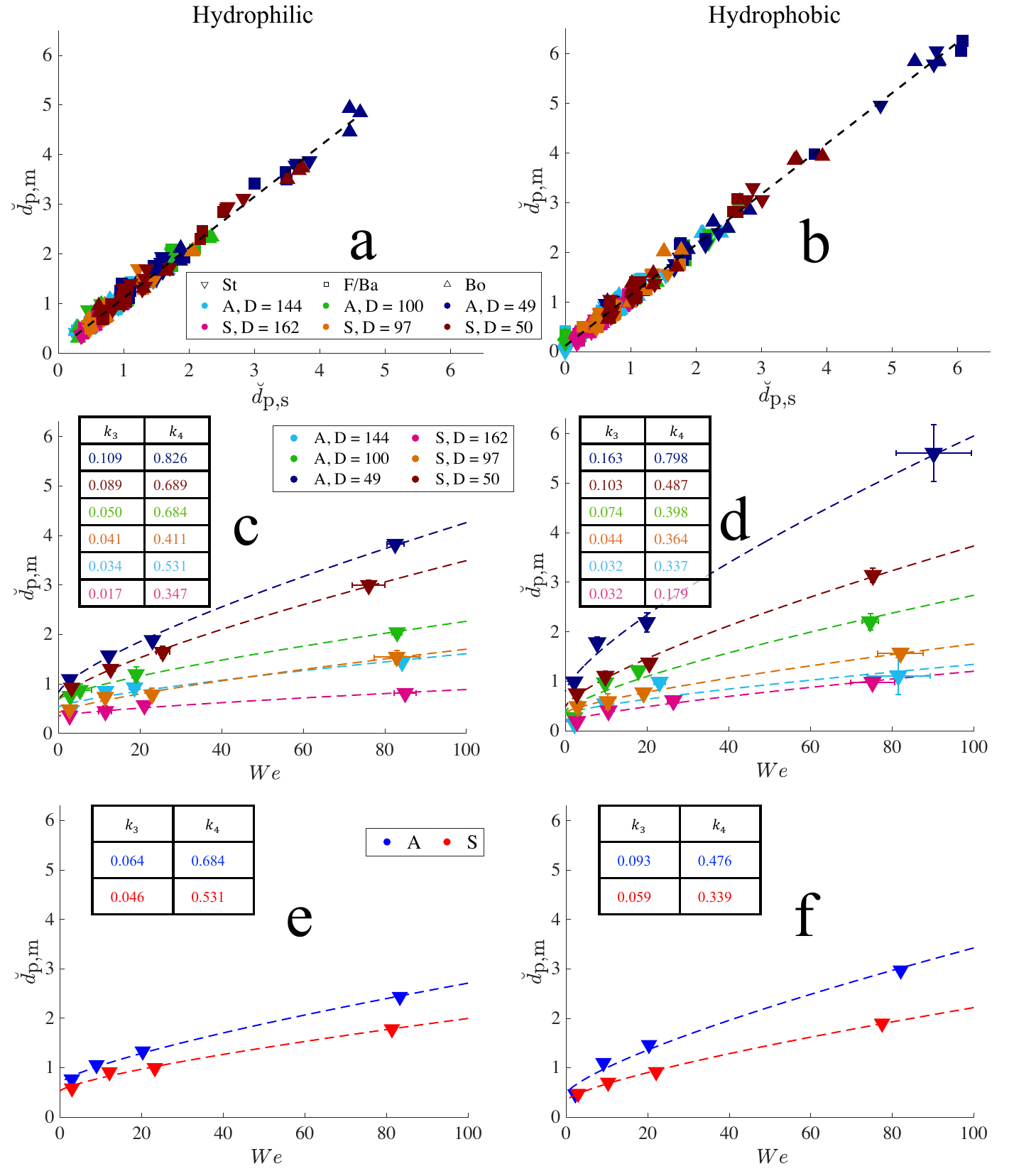
Normalized maximum penetration depth versus Weber number for hydrophilic (left) and hydrophobic (right) arrays at three densities (about 50, 100, and 144 strands/cm squared), aligned vs staggered. As density rises toward the density of natural pelts, the curves flatten: a dynamic ceiling on penetration that natural pelts already exploit.