This experimental work explores the relationship between the properties and structure of mammalian fur from different habitats and the depth of water drop penetration when impacted in succession. For most mammals, water penetration depth reaches a saturation point, beyond which it no longer increases, creating a dry insulating air layer near the skin regardless of repeated water impacts. To understand this phenomenon, we define several dimensionless quantities representing fur macro-properties, such as guard hair and underfur densities, guard hair and underfur lengths, contact angles, and equivalent diameters. Additionally, we examine microscopic properties such as the aspect ratio and roughness of individual fiber scales. We establish connections between these macro- and microscopic characteristics, the thickness of the dry zone, the depth of water penetration, and the rate at which penetration depth decays exponentially. Our results show that the distal diameter influences the rate at which the penetration depth of water decays with additional impacts. Generally, a higher pelage density, larger guard hair diameter, and increased fur roughness contribute to a thicker dry zone. Using digital microscopy, we confirm that mammalian guard fur is hydrophilic, resisting dynamic penetration, whereas the finer and denser underfur is hydrophobic, resisting static penetration. This dual-layer structure allows mammals to resist wetting during a heavy rainfall.
How it works and what we found
Cataloging fur across habitats
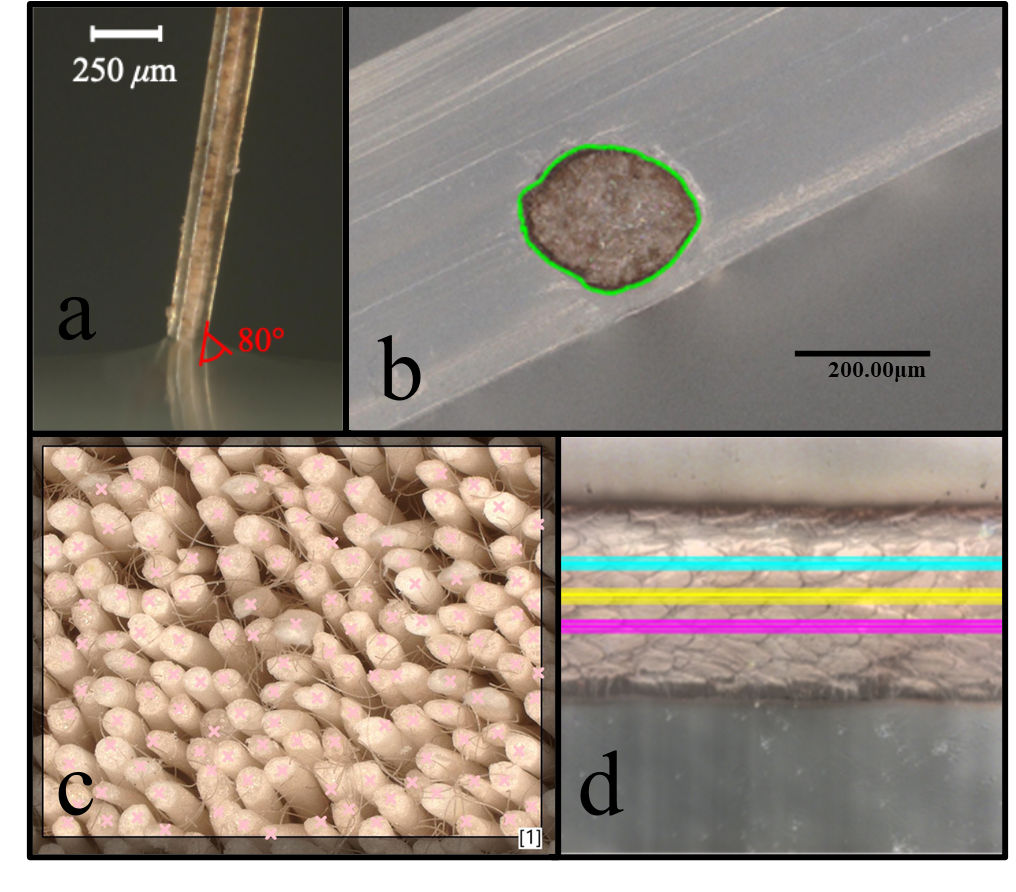
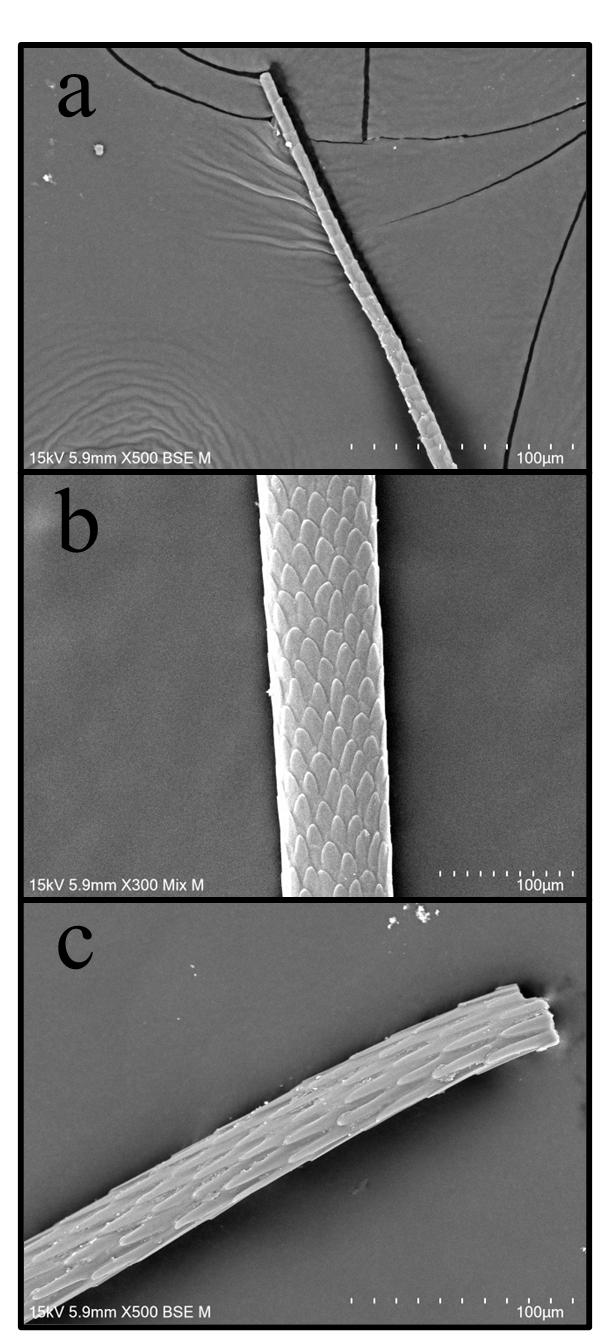
We sample fur from six mammals spanning terrestrial, semi-aquatic, and fully aquatic habitats. For each pelt, we quantify guard-hair and underfur length, density, contact angle, equivalent diameter, plus microscopic scale aspect ratio and roughness.
Why penetration depth saturates
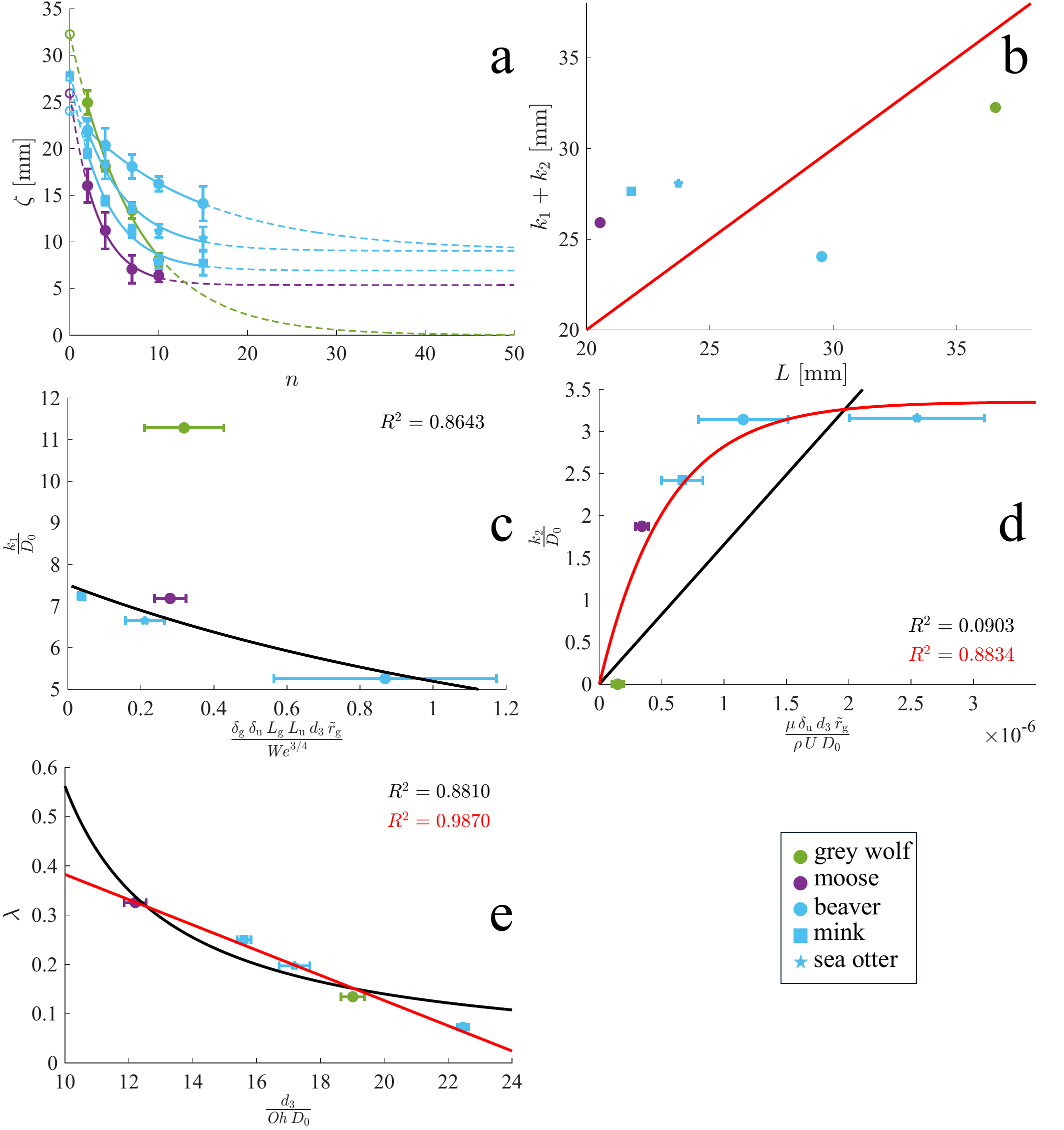
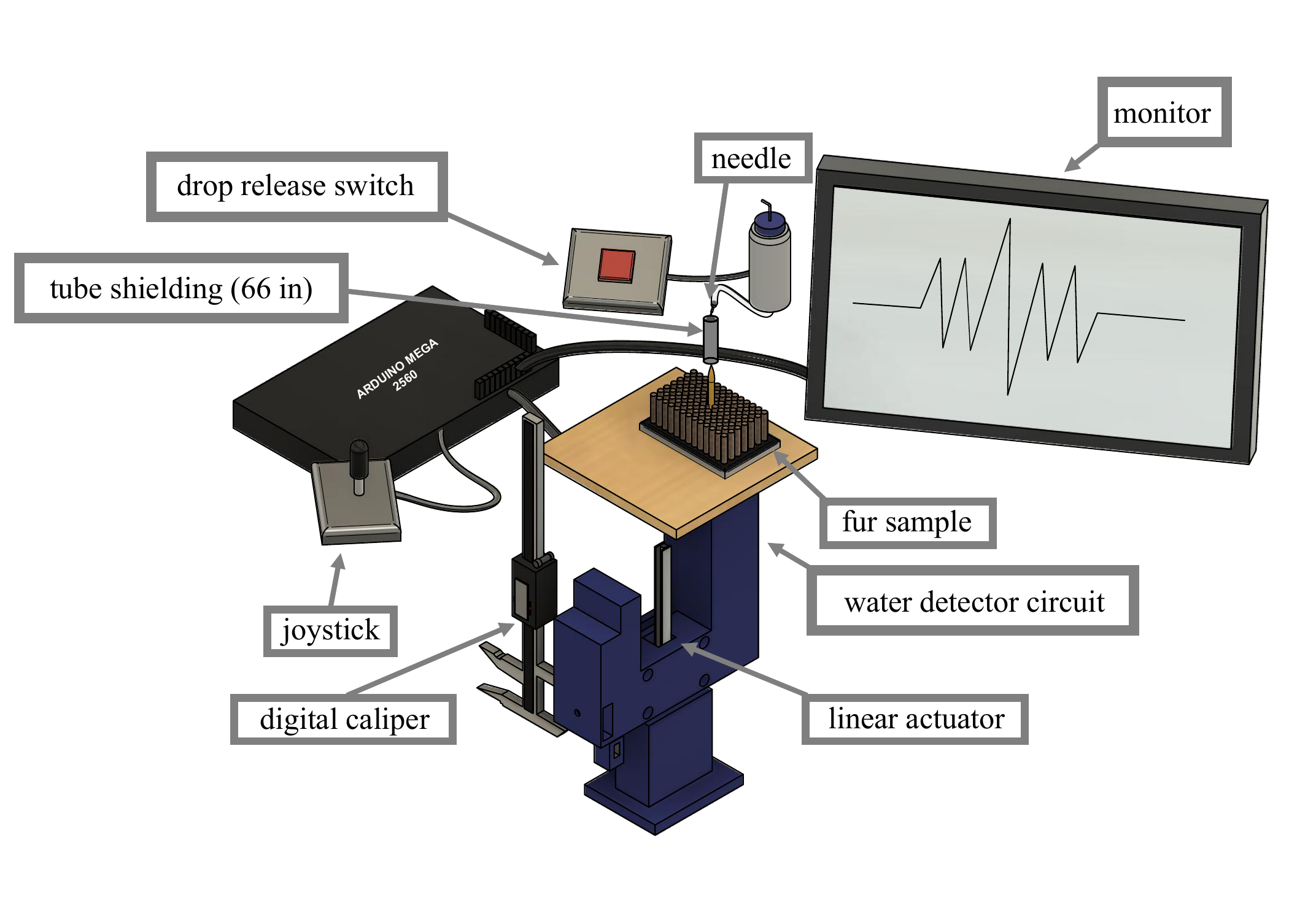
Repeated drop impacts deepen the wetted column up to a point, after which the dry air layer near the skin remains stable. We model the exponential decay of the per-impact depth gain.
Two layers, two wettabilities, one barrier
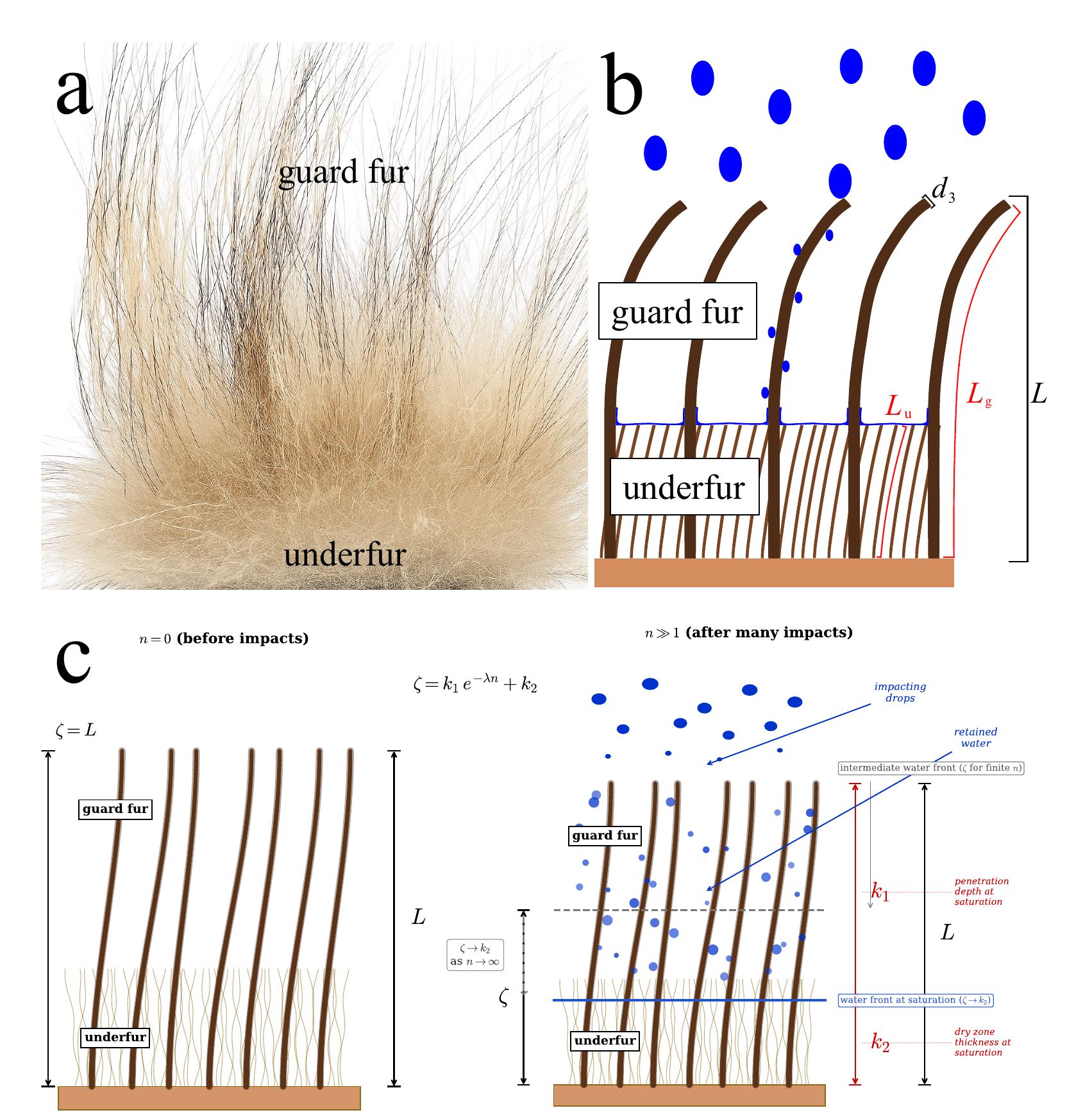
Digital microscopy reveals that guard hair is hydrophilic (resisting dynamic penetration by spreading impact energy laterally) while underfur is hydrophobic (resisting static penetration by capillarity). Together they form the dry barrier.
Distal diameter controls how fast saturation arrives
Among the macro variables, distal guard-hair diameter sets the decay rate of per-impact gain. Pelage density and roughness set the saturation thickness.