← Back to the anthology

Cross-sectional circularity promotes dynamic drop penetration of horizontal fiber arrays

Circular fibers let drops in by 26% more than wedged ones, despite being more hydrophilic. Geometry overrides wettability.

Gene Patrick S. Rible*, Syed Jaffar Raza, Jackson H. Boger, Hannah H. Osman, Aidan D. Holihan, Braeden K. Elbers, Kyle R. Brown, Christopher M. Schenck, Benjamin J. Reed, Andrew K. Dickerson
Department of Mechanical, Aerospace and Biomedical Engineering, University of Tennessee, Knoxville, Tennessee 37996, USA
*Contact researchers: grible@vols.utk.edu

Physics of Fluids 37, 122110 (2025)

Abstract

In this experimental work, we compare the drop impact behavior on horizontal fiber arrays with circular and wedged fiber cross sections. Non-circular fibers are commonplace in nature, appearing on rain interfacing structures from animal fur to pine needles. Our arrays of packing densities of ≈50, 100, and 150 cm⁻² are impacted by drops falling at 0.2–1.6 m/s. A previous work has shown that hydrophilic, horizontal fiber arrays reduce dynamic drop penetration more than their hydrophobic counterparts. In this work, we show that circularity, like hydrophobicity, increases drop penetration. Despite being more hydrophilic than their non-circular counterparts, our hydrophilic circular fibers promote drop penetration by 26% more than their non-circular counterparts through suppression of lateral spreading and promotion of drop fragmentation within the array. Circular fiber cross sections induce a more circular liquid shape within the fiber array after infiltration. Using conservation of energy, we developed a model that predicts the penetration depth within the fiber array using only measurements from a single external camera above the array. We generalize our model to accommodate fibers of any convex cross-sectional geometry.

Firsts in this work

New experimental tools and observations from this paper.
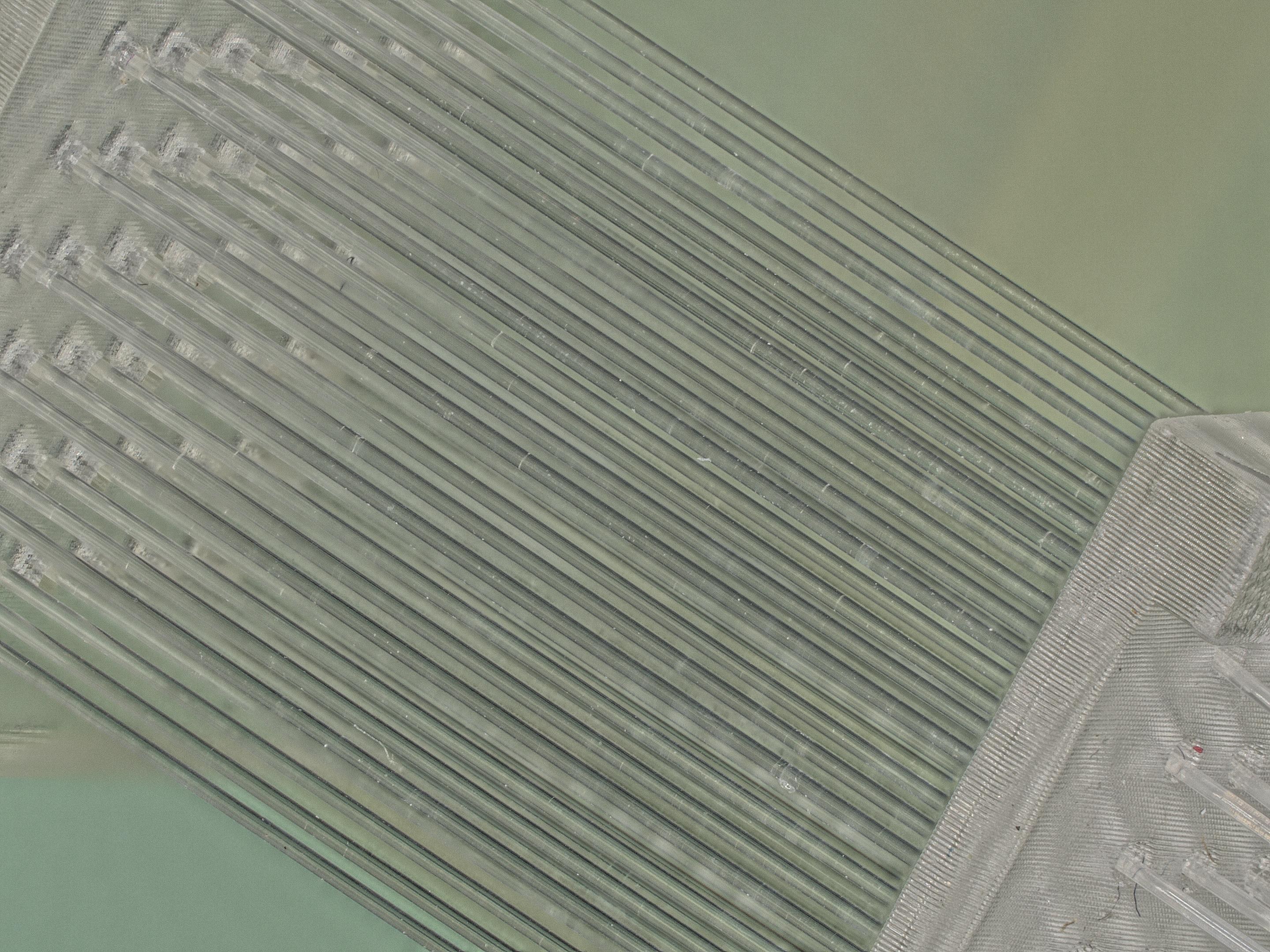
Threaded circular-fiber array mimicking fur, against a green background. The nylon-threaded circular fiber arrays used in this study.

How it works and what we found

Why fiber shape matters separately from packing density

Movie 1: Drop impact classifications, shape / retraction / fragmentation

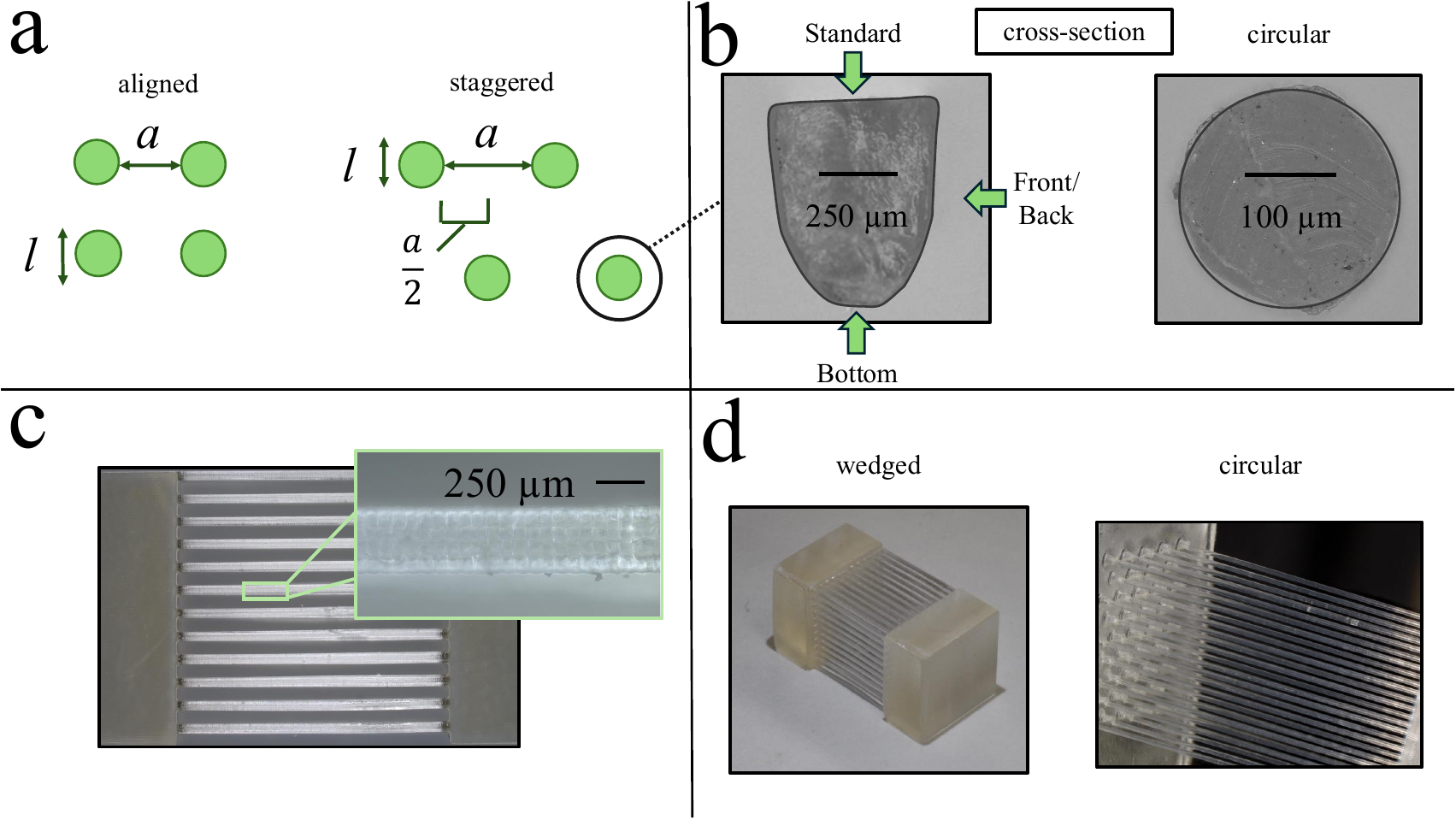
Figure 1 from the paper: wedged and circular fiber arrays. Cross-section of aligned vs staggered configurations, cross-section of wedged vs circular fibers with the standard, front-back, and bottom impact orientations, top view of wedged fibers, and oblique view of wedged and circular fibers.
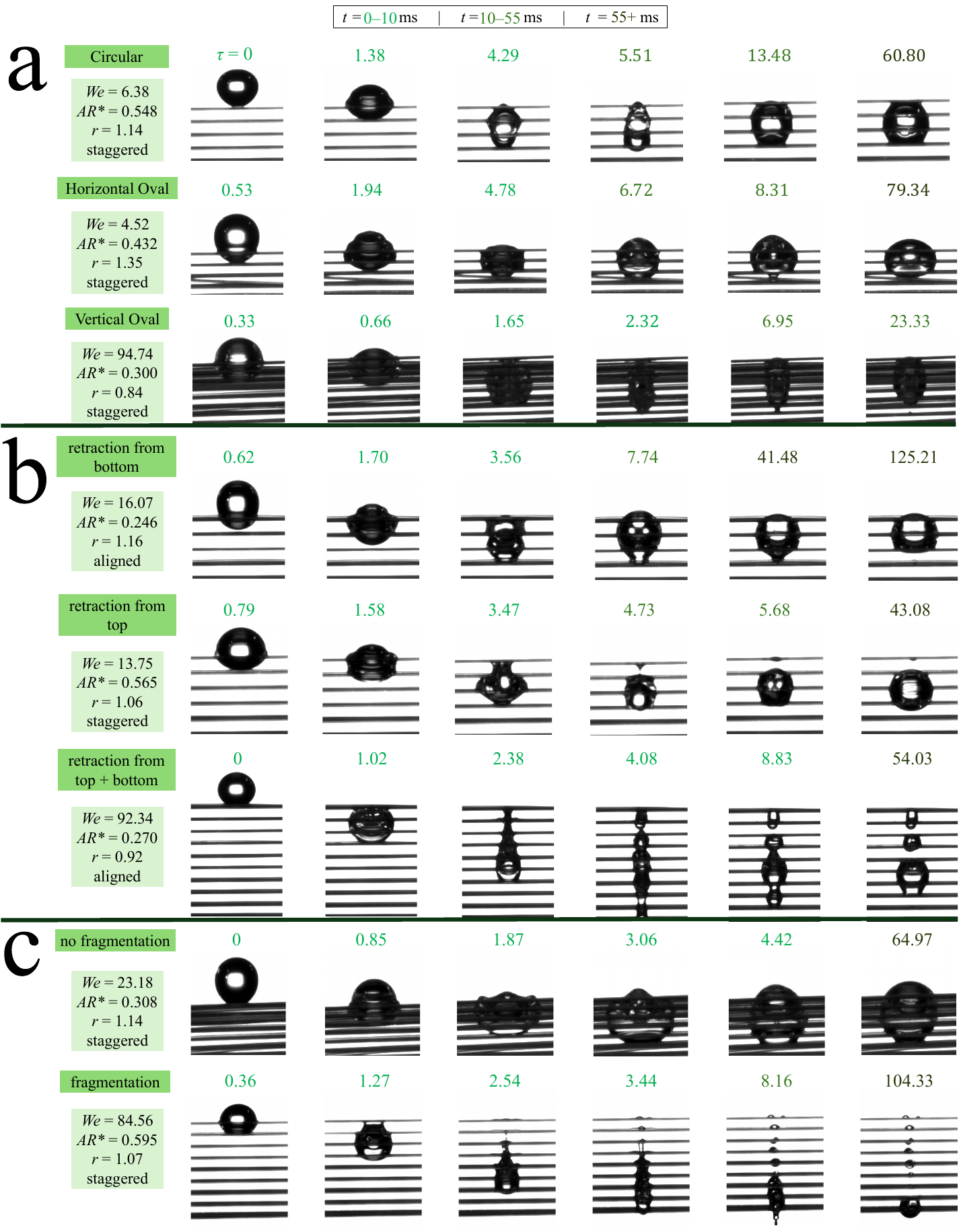
Figure 5 from the paper: drop impacts classified by steady-state shape, retraction, and fragmentation, shown as image sequences for drops impacting hydrophilic circular fiber arrays.

Holding wettability and density constant, we compare circular and wedge-cross-section 3D-printed fibers under identical impacts.

Geometry overrides wettability for penetration

Movie 3: Full penetration of circular fiber arrays at We > 1000

Movie 2: Hydrophilic vs hydrophobic circular fiber penetration

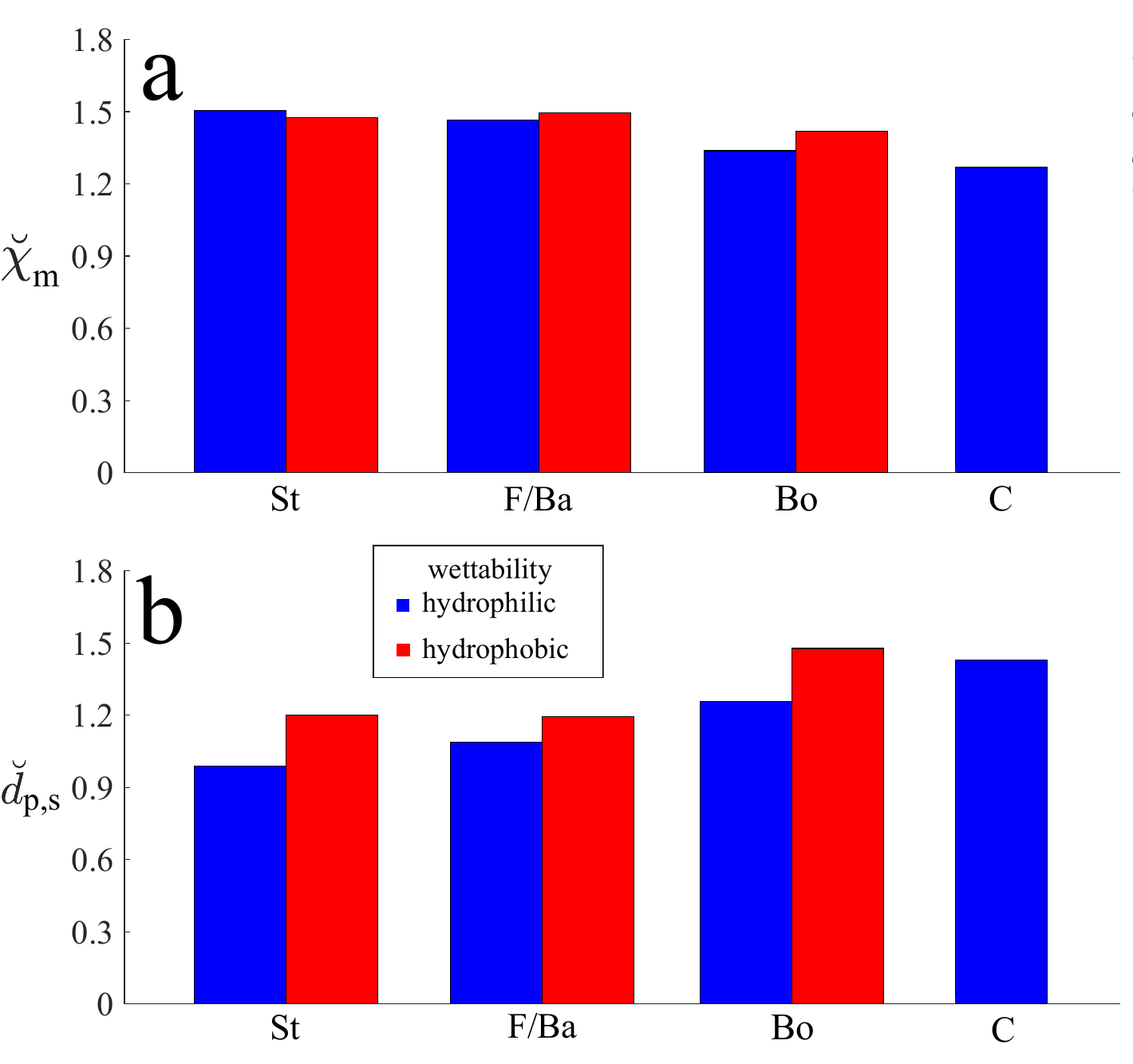
Figure 12 from the paper: bar plots of average maximum spread and steady-state penetration depth for hydrophilic and hydrophobic standard wedged, front/back wedged, bottom wedged, and circular fibers. Shows circular fibers spread least and penetrate most.

Circular fibers reduce lateral spreading and promote fragmentation inside the array, deepening the wetted column by 26% on average. Despite being more hydrophilic than the wedge case, circular fibers let drops in more readily.

Energy model from a single top-down camera

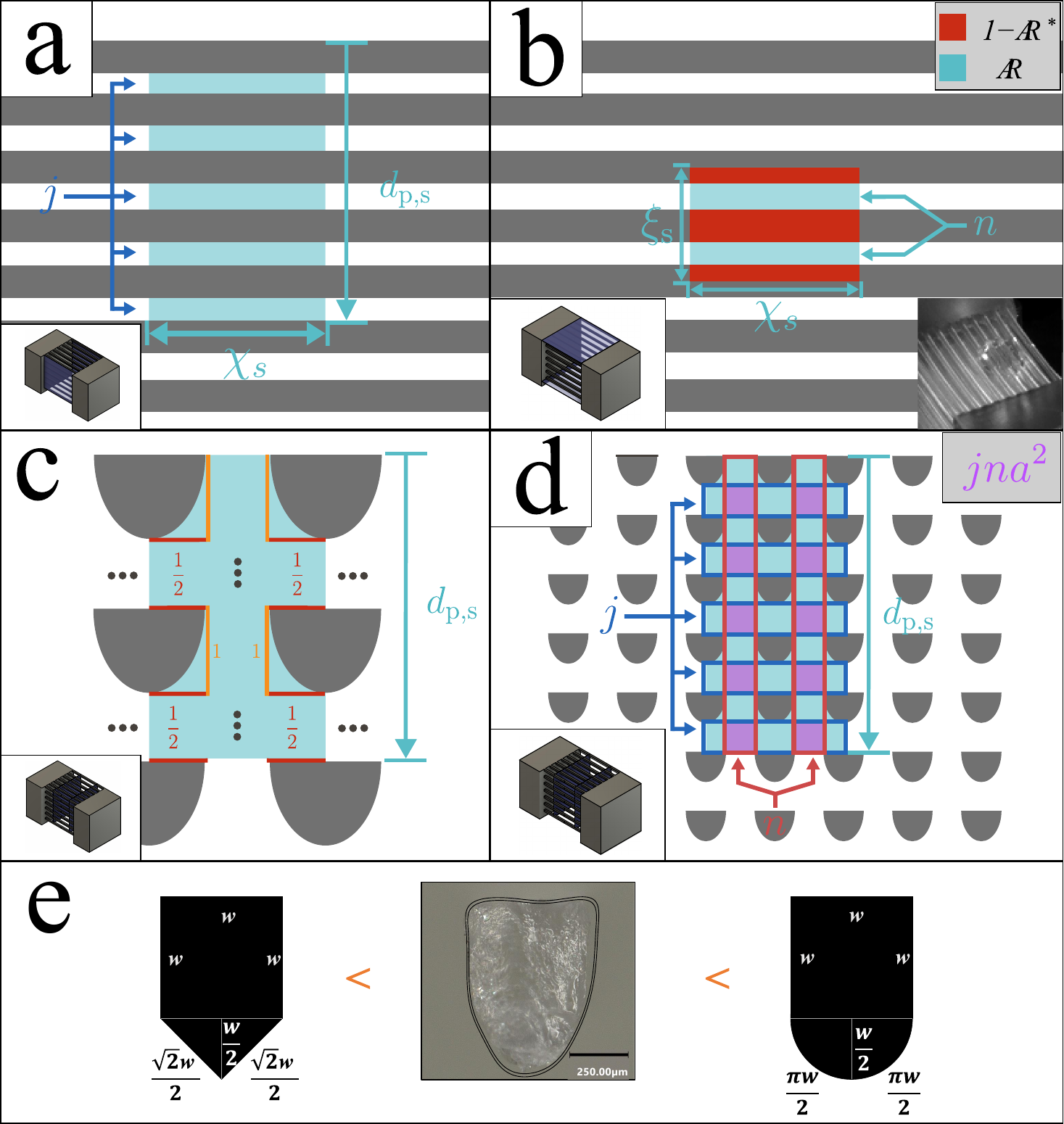
Figure 18 from the paper: liquid infiltration in a fiber array shown from front view, top view, and side view, with the approximate wedged-fiber geometry. The geometric basis of the energy-conservation penetration-depth model.

By balancing kinetic energy at impact against the work done by drag and capillary forces in the array, the depth can be inferred from a single external view, sidestepping the need for internal imaging.

Generalization to any convex fiber shape

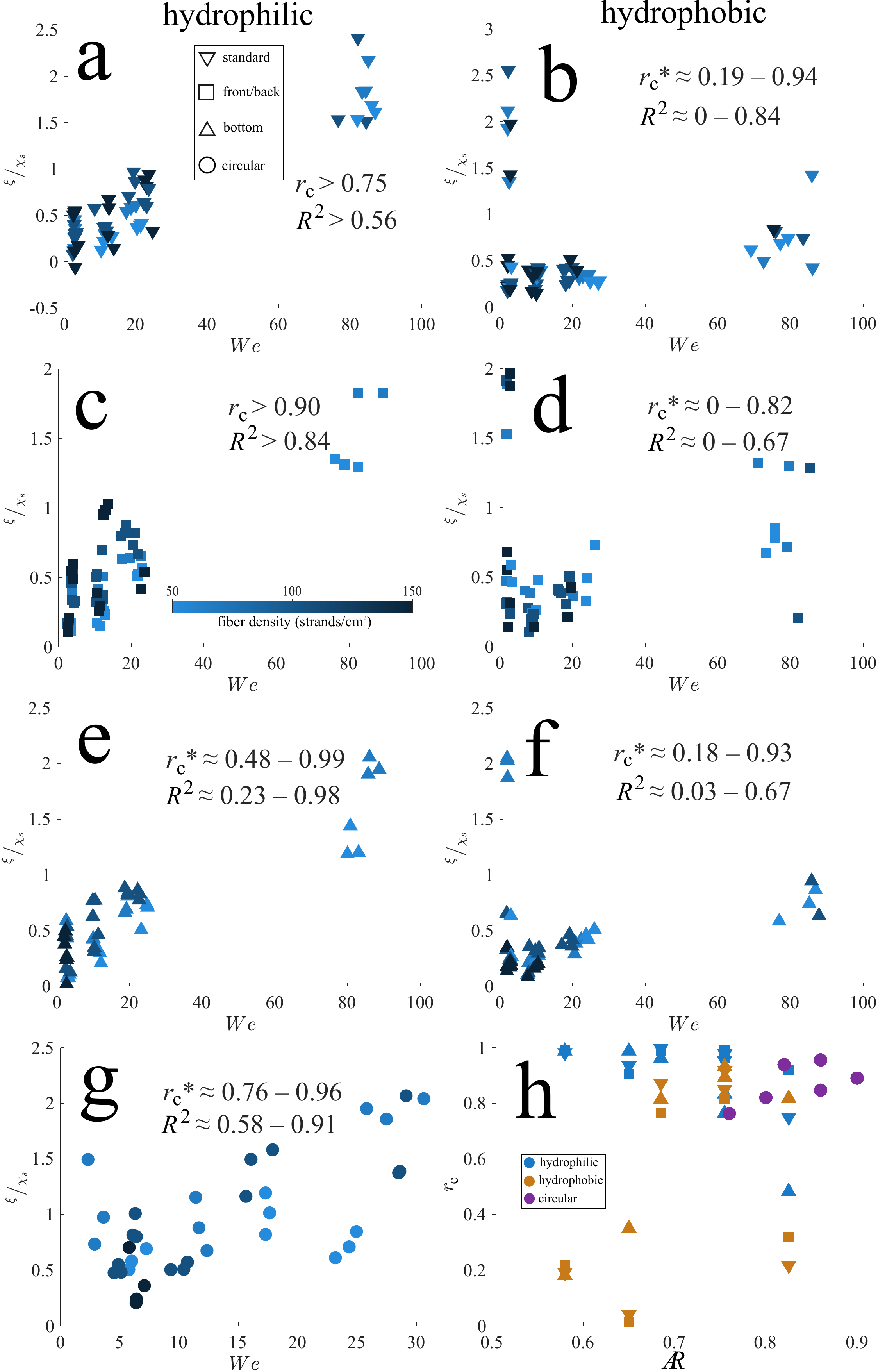
Figure 19 from the paper: ratio of anteroposterior to lateral spread versus Weber number across all fiber cross-sections and orientations, with a panel plotting the model correlation coefficient versus fiber aspect ratio for hydrophilic, hydrophobic, and circular fibers. Validates the generalized model across convex geometries.

We recast the model in terms of geometric moments that work for any convex cross-section, opening the door to direct comparison with natural fibers (mammalian fur, pine needles, plant trichomes).

Supplementary videos

Watch all of them as a playlist on YouTube →

Movie 1: Drop impact classifications, shape / retraction / fragmentation

Image sequences of drops impacting hydrophilic circular fiber arrays, classified by steady-state shape, retraction, and fragmentation. Pairs with Fig. 5.

Movie 2: Hydrophilic vs hydrophobic circular fiber penetration

Image sequences comparing drop infiltration into hydrophilic and hydrophobic circular fiber arrays at matched density and impact velocity; penetration is deeper in the hydrophobic case. Pairs with Fig. 10.

Movie 3: Full penetration of circular fiber arrays at We > 1000

A drop impacting at a Weber number above 1000 fully penetrates a hydrophobic circular fiber array. Pairs with Fig. 17.

Citation

@article{rible2025crosssection,
  author  = {Rible, Gene Patrick S. and Raza, Syed Jaffar and Boger, Jackson H. and Osman, Hannah H. and Holihan, Aidan D. and Elbers, Braeden K. and Brown, Kyle R. and Schenck, Christopher M. and Reed, Benjamin J. and Dickerson, Andrew K.},
  title   = {Cross-sectional circularity promotes dynamic drop penetration of horizontal fiber arrays},
  journal = {Physics of Fluids},
  volume  = {37},
  number  = {12},
  pages   = {122110},
  year    = {2025},
  doi     = {10.1063/5.0287633}
}

Acknowledgments

This research was partially funded by the National Science Foundation (CMMI 1825801 and CBET 2153740). We thank Mohammad Alipanahrostami and Dr. Wei Wang for coating our hydrophobic fibers in their laboratory.

Discussion

Questions, comments, and follow-up work. Sign in with GitHub to post.